Wednesday, February 20, 2019

Pre-Spring Chicklets Arrived

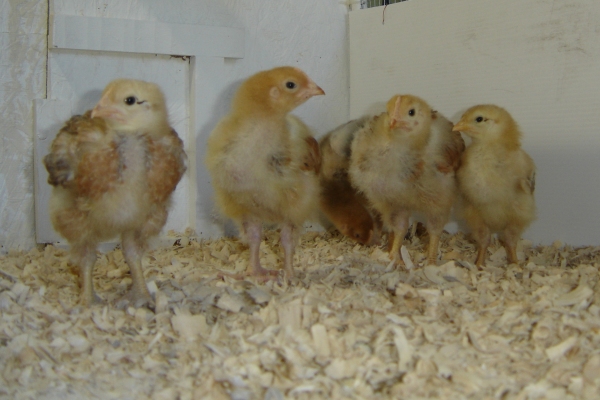
Nine little fluff balls arrived this morning.  We have them in our small cage with high sides for now, to make it easier to control the environment.  We have the brooder warmer at the low height and they are all piled under there as they adapt.  Since the garage is on the cool side right now, we have added a space heater to blow a little warm heat in there.  Of course, we also have the cage covered with a sheet to cut down on drafts with the one foot wide opening at the far end of the cage (away from the chicks) to ensure that they are in a warm, but not too warm environment.  If it is too cold, they won't leave the brooder warmer for the food and water. It can be quite the task to find just the right temps on these cooler winter days as we head into spring. 

These are only the Cornish Cross - meat chicks.  No layers this year.  We will replenish the layers next year. So, it's the start of the new flock. 

Cornish Cross huddled under the warmer.

Saturday, February 9, 2019

Late Winter Arrival 2019

So it has been a while since I last posted last fall.  We had an incredibly warm winter with a lot more sunshine than normal. We did something different this winter. Rather than put lights in the coops, especially while the Welsummers were recovering from moult, we decided to wait to see how long, in the shorter light days, the Rhode Islands would lay eggs.  Unlike our previous pullet breeds, the Rhode Island Reds continued right through December 21st laying two to three eggs per day. So we never bothered to install the timers and lights.  We wonder if a part of that was because of the warmer and sunnier winter.

The first of the Welsummers just started laying an egg every other day on January 28th. She seems to be the only Welsummer laying. 

The last part of January, the Mid-West and East Coast started dealing with a Polar Vortex, while we continued with our warm weather. Then, the last few days of January, we got some colder nights with snow and ice. Not much to speak of. About two-three inches of really wet snow, and I didn't even bother taking pictures because it was mostly gone within a day.  The ice stayed, and each morning was a little too cold to keep water out in the coops. We have been pulling the waterers out of the coops each night so that they don't freeze.  At night, temps have been dropping down to the low 20Fs. 

Rhode Islands are still laying every day, unfazed, so far, by the cold nights. 

Tonight we are supposed to get significant snow for the weekend and possibly into Monday or Tuesday. Because all of my coop covers are iced over, I could not move them into place. OY Vey. I cobbled together some covers with plastic, canvas tarps, bricks, and even a folding dog pen.  I just hope they all stay in place. This could prove to be the wrong strategy.  Hoping it lasts at least through the night until I can get the rest of the family members to help me pull in in better covers.

Update - Last night's snow accumulation. About 5 inches of snow.

Looking Northwest at Coops

Changed Light Filter

My Magnolia Top

Magnolia bottom

Greenhouse looking Southwest


Saturday, October 20, 2018

Pesky Leaf Miners in my Spinach

I was asked what is a Leaf Miner.  I'm no expert on the topic, bug, or control. All I know is that there is a little fly that resembles a house fly that lays tiny white eggs on the underneath sides of leaves, and when the eggs hatch, the larva starts munching away on the underneath side of the leave, taking all the juicy nutrients out.  On the top side of the leaf, it looks like a whitish lesion or strip has been damaged.  In a day or two, the leaf curls and shivels around the damage. At first, I thought it was sun damage. 

I routinely (daily) check the leaves for the tiny white eggs.  I scrape off the eggs with my fingernail and flick them out into the grass.  I have read that it is not a good idea to pull the leaves and put them into compost, as this becomes a perfect area for them to breed and grow within the breakdown.  I don't know for certain, that's just what I read. I put damaged leaves into my burn pile or garbage. There are probably better treatments to stop the flies from laying eggs.  I just try to stay organic, and in my micro garden patch, it is not that difficult to check the leaves every day or every other day. 


Leaf Miner Larva Damage

Leaf Miner Eggs are White and in rows

Close up of Eggs

Close up of damage

Leaf Miner Fly *


*Resource - "https://www.daylilies.org/ahs_dictionary/leafminer.html"

One Month into Fall 2018

Here we are, one month into the fall season, and the weather is polar opposite of this time last year. We have sunshine, albeit breezy, and temps in the 70s during the day. This year, my fall garden is so much better than last year.  Some things I learned is to have most of the fall veggies in pots/buckets in order to be able to move them quickly into the green house, in the event the over night temps drop into the low 30s.  Otherwise, I leave them outside over night, for any rain or dew.  One thing to watch for closely are bugs that want to lay eggs in the soil.  One way to cut down on this is to sprinkle DE (diatomacious earth) that is "food safe" around the plants onto the soil.  This will kill and/or detract most bugs. Also, watch for leaf miners that lay little white eggs on the under side of the leaves. The culprit looks like a house fly. But, the eggs, as they hatch will take all the nourishment from the leaf, causing it to look like a slug crawled over it.

So far, the bell peppers (in the green house 24-7) are still producing cute little peppers. The strawberry starts all took and are looking great, as the older berry leaves are turning red and brown. The oregano has slowed its growth, but we can still harvest any that we want.

Fall plants, carrots, spinach, garlic and cilantro are knocking it out of the park this year. Could not ask for a better bunch of plants. I have planted a second fall start (fingers crossed) of spinach and lettuce.

30 carrots in a container

Topdown carrots

Fall Cilantro

Fall Leaf Lettuce

Fall Strawberry Starts

Fall Spinach

Leftover Bell Peppers

More Bell Peppers


Three of the four Welsummers are in full moult, while one continues to persist laying an egg every other day. She seems quite proud of herself.  The Rhode Island Reds are continuing to lay three eggs per day for us, so we are plenty in the eggs this fall. Considering that there are only about 11 hours of daylight per day, and we have yet to put any wattage into their coop yet, I am in no hurry to take the electricity out there, just yet, while they continue to lay an egg per day. 

The Freedom Rangers are 10 weeks of age, and we will process them next weekend. They are good sized.  I speculate that they will each weigh about 5 - 6 pounds processed. There are three cockerels and three pullets.  The cockerels are crowing every morning and every evening... they seem most intrigued by the hens in the other coop, since the pullets are not mature enough for mating purposes. 


All six Freedom Rangers

Two Pulls and Two Rels

Pullets Leaning into the Breeze

Good Size!

Back to the feed trough

Sunday, September 23, 2018

Moult, Eggs and Garden

The Welsummers have headed into their first moult. One hen has already lost a lot of her wing and breast feathers.  The others are looking pretty fluffy (a lot of down feathers are being exposed). Time to take the oyster shell away and we will need to switch over to starter/developer feed for higher protein content.  Rhodies will not moult this year as this is their first year. This means that the Welsummers probably won't be back to laying until December or January.

The Freedom Rangers are doing well outside.  They are foraging (like heritage chicks) and seem comfortable outside. They don't seem too flightly with the sounds. We do have to round them up after dark as they are not inclined to want to go inside at night. That's good though, as that means that they are foraging well into the evening.  

The first few weeks of September have been excellent fall temps, high 60s and low 70s.  Greenhouse lettuce is growing well, the outdoor plants, cilantro, carrots and spinach are loving these temps. 

Picked up garlic starts today. I'm soaking them overnight and will get them in the dirt tomorrow.  I picked up some different organic fertilizer, Bio-Live.  I can work this into the dirt tonight for tomorrow's planting. Should be great for a lot of our under the soil growth, i.e. carrots, garlic, onion and potatoes. Time will tell.  

No Photos today.

Monday, September 17, 2018

Outdoors a Week Early

While the clucks are not fully feathered at five weeks, the day time temps are above 65 this week, and, as such, should be fine outside for the chicks.  We have a little heat lamp inside the coop for warmth at night. If it gets too cool at night, we can close up the coop tighter for added warmth for them.

One of the six cluck clucks is rather smallish in comparison, but is eating hearty, so it may just be a smaller chicken.  The others are quite a bit larger, which is a good sign. The smaller one is at the feed trough in the first photo with black spots on its back. But, in truth, they are still small compared to the Cornish Cross, at this age. Even the larger ones have to stretch to get to their water. Their eyes are an interesting color of grey with speckles of blue.  The photos do not do it justice.


Little Cluck at the Feed Trough

Swollowing that drink

Little Peep standing next to the bigger peeps.

Checking on the Feed


Sunday, September 2, 2018

September Time, Squawk Flock & Fall Plants

The Freedom Ranger chicks are three weeks now, with most of them having their long necks established. Although the chicks are growing faster than layers seem to grow, they are not quite the equivalence of the Cornish Cross, especially in the legs and breast areas.  The pecking order happens quickly with these chicks.


Natural Lighting 

Squawk Flock with Flash for Light

The Long Necks are Here

Two Roo Face Off?

The garden is winding down.  I did harvest the last of the carrots out of the garden space. I cut back the basil and cut half of the dill.  One has gone to seed, so we may save those seeds for next year. The few remaining onions were toast.  I ended up putting a lot into the compost bin. The corn is on its final stand.  The nights are getting too cool and the few remaining ears of corn are not in the best shape. The final tomatoes are getting red. The bell peppers are blooming again and we have a few small peppers developing.  We will keep them in the greenhouse for protecting and warmth at night. 

Fall plantings are kicking in. I planted another row of spinach today.  The center row is leafing already. The cilantro is looking better. The fall planting of carrots is in a deep planting bed that is movable, if we need to haul it into the green house. I have two new buckets of leaf lettuce planted.  I planted them about two weeks apart so that we are not so wasteful with it. I hate when I have to throw out plants that rotted. It is one thing if it is because of bugs, but a whole different feeling when we had too much and could not harvest it in time. Oregano is popping up with gusto. 


Carrots

Cilantro

Leaf Lettuce

Oregano

September 1 Leaves

Fall is near