Saturday, April 3, 2021

Watching Chicks Grow into Chickens

The past couple of years, we have taken on a new adventure during the Covid Pandemic.  We started raising new hatchlings into young pullets that are ready to go outside. So we have had the opportunity to take weekly photos of them as they are growing.  For example, the Rhode Island Reds are a popular breed that we start for others. 

Week 1

Rhode Island Reds Week 1

One week after hatching, they are squatty little fuzz balls.  Apologies on the blurry photo, but they tend to move really fast at this age and are less likely to pose.  The first week or two, chicks are the most vulnerable to temperatures, stress, and crowding. When afraid, they tend to trample one another. They are also prone to a condition known as Pasty Butt, where the poop mats over their vent to their "butt down" and they can die if it is not removed quickly enough. Feeding them cooked/mashed egg yolks two or three times per week can help reduce pasty butt.  Also using a teaspoon of raw apple cider vinegar (like Braggs) in a quart of water for them to drink can help their immune system. They are just starting to get a few feathers on their wings, but for the most part, they are simply covered with down. These two are both pullets (females). They will grow way faster than you can ever anticipate, and within a few weeks, they will be creating quite the stink and cloud storm as they try to start to fly. But for the first week, or two, keeping them inside a house in a brooder is okay without too much of a mess. 

Week 2

Rhode Island Reds Week 2

Rhode Island Reds Week 2 wing and tail feathers

They are growing quickly. They have almost doubled in size even though they do not look like they have. They are much less prone to pasty butt after two weeks, but it can still happen, into their third week. They are still very squatty in appearance. Their beaks are growing stronger and may develop color on the tips, depending on the breed. They are growing more wing feathers, and they are starting to get distinct tail feathers. The interesting things about the Rhodes is that the color on their wings now is not what it will be in a few weeks. After two weeks of age, you can stop feeding the eggs with their feed, and start providing small amount of treats, like chopped up apple, mashed canned corn, or finely chopped broccoli, along with sand or very fine grit twice per week.  This helps them to become accustomed to these treats when they get older. (Not too much and not daily. It will mess with their development and egg production, if they get too fat.) 

Week 3

Rhode Island Reds Week 3

Rhode Island Reds Week 3 more feathers again

Now their legs are growing longer and they are starting to stand a bit more upright. From the front, they still look cream to tan in color, but when they turn around, you start to see the reddish color coming in down their backs, and towards their tail feathers. They are not as vulnerable to the temperature, but they are vulnerable as they attempt to fly. They can smack into objects and get hurt because they do not yet have the skills they need to fly safely.  They are ready for toys in their brooder.  A mirror or two, and a bell.  A colorful cat ball to roll around with a bell inside is also fun. A rope swing or a branch perch is also fun to try to fly up to, and fly off of. At this point, make certain to have plenty of floor space for your chicks. At least 1 square foot per chick to keep their stress levels down. Do no count the space that the food, water and other things take up in the square footage total. Not enough space and they may start pecking on each other. That's never fun to deal with. 

Week 4

Rhode Island Reds Week 4

Rhode Island Reds Week 4 Starting to get Red Feathers

At four weeks, they are better at flying with more sturdy wing and tail feathers developing. A lot less down on their bodies at this point, and they are starting to stand more upright, look a bit gangly, and hve quite the mix of down and feathers. I call this the long neck stage as they can really stretch out their necks now. But when they want to, they can look quite compact and squatty like little chicks. That's the nature of the 4 week old chick. Their heads are still mostly down and cream colored. But if you look closely, you see that feathers are starting to develop up onto their necks and down the sides of their chest to the tops of their legs. The true mahogany red color is filling in on their bodies.  Their flying skills are much more adept now, plus their pecking order is well established.  The dominant birds will be the first to fly or run towards you, while the less dominant birds will hang back in the flock.  They are able to eat small seeds and cracked corn as occasional treats now, as long as you include some grit with it. They also may like to experiment with dried meal worms that are not too large in size. Keep the toys in the brooder to give them distractions and to help the more timid birds to get some reprieve from the dominant ones. 

Week 5

Rhode Island Reds Week 5

Rhode Island Reds Week 5 Almost Fully Feathered

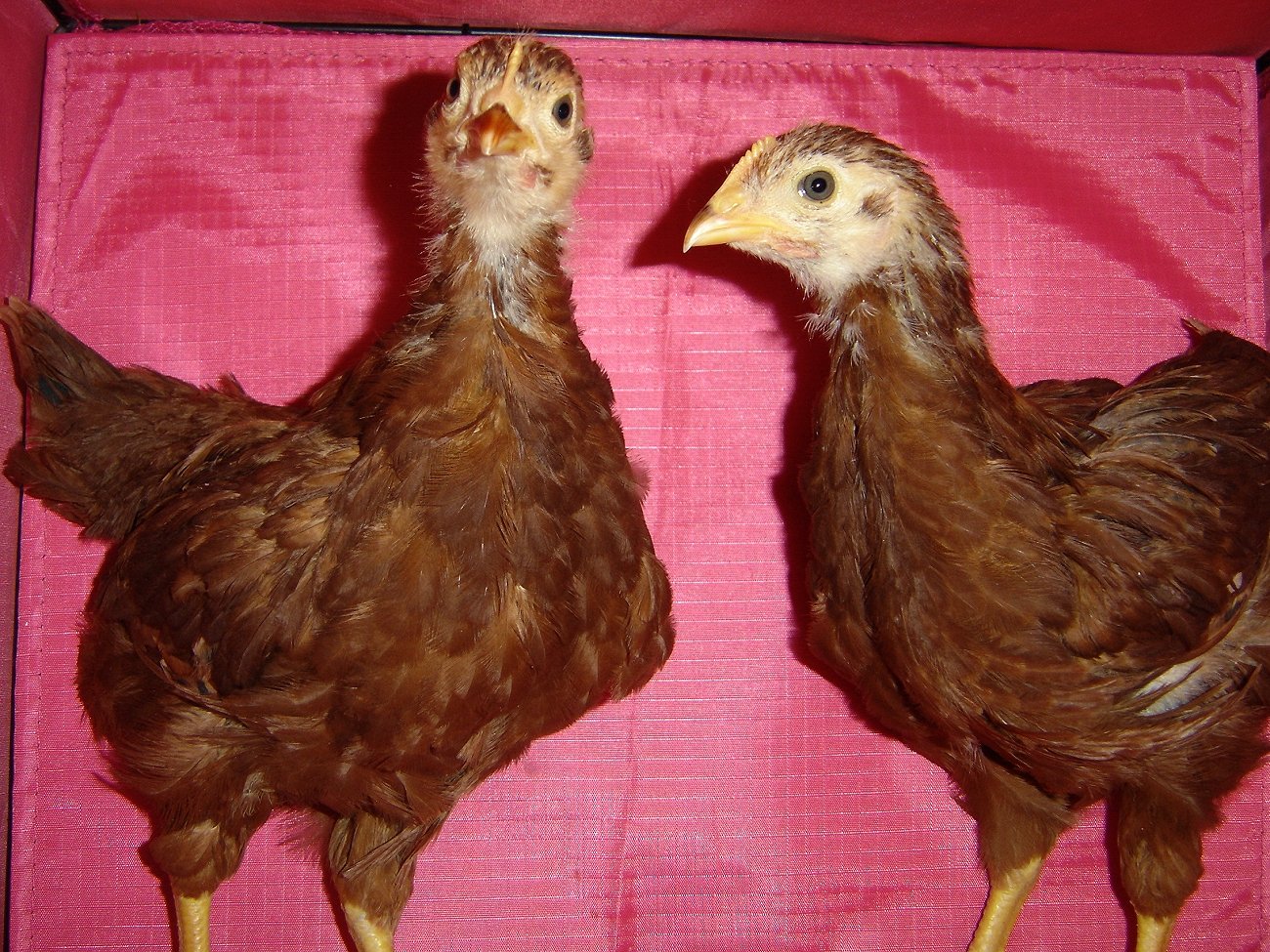
The first real resemblance of being mature chickens now. They are taller. Definitely more upright and almost fully feathered.  Their feathers are starting to form on their heads, but there is will some down on their chests, on the top of their heads, and a little around the top of their necks. This is really the last area on their body where they are not quite insulated enough to go outside, if your area is below 55F at night. You need to wait until those down feathers are really gone.  Once they are fully feathered, they are ready to live outside with a coop for them to sleep inside safely on a roost. At this point, my chicks are already sleeping on a roost in their brooder at night without a heat source in the barn, as long as the temps do not drop below 45F in the barn.  I have a small space heater near their brooder set to come on and warm the air around the brooder, if it gets too chilly, especially in the early spring. The chicks, as almost young pullet chickens, will need more floor space again.  At this point, they will need at least 1.5 square feet per bird to reduce stress levels and space to do their thing.  Yes, I get that sometimes, you will see them all huddled together, sleeping soundly in the corner of the brooder or side by side on the roost, but that is not a constant, buddy-buddy stance.  They need their space to exercise and act like chickens, too. 

Week 6 

Rhode Island Reds Week 6

Rhode Island Reds Week 6 Almost Completely Feathered

The amazing transformation of the chick into a young chicken happens spectacularly fast. Their chests, sides, backs, wings, tails, and the tops of their legs are fully feathered now. Their heads are just about feathered with only a little down peeking through those new feathers. Depending on the weather outside, they might be ready to go live in their coop without any additional heat source.  If your nighttime temps are dropping below 45F and your daytime temps are consistently below 55F, then I definitely recommend that you include a heat source, whether it is a brooder warming plate, or a coop heating panel, for a couple of weeks. It is not a good idea to use a red heat lamp unless you have a very large coop where you can hang the lamp safely away from the birds and won't catch anything on fire. Until their heads are fully covered with feathers and they have had a chance to acclimate to the cooler temps, by being outside a week or two, you can then take the heat source away and they should do just fine, unless it starts snowing/freezing outside. That happens sometimes during mid-spring in our area. 

Personally, we don't use a heat lamp with our brooder chicks because we know of too many people that have lost their chicks and homes to fires caused by them. We rely on the brooder warmer panels to keep our chicks safer, warm, and healthier.  Our chicks are less stressed out because they use the panels to hide under when they get scared, or cold.  During the first week, we keep the food and water close to the panel. Week two, the food and water is moved a foot away from the panels. Week three, the food and water is moved totally away from the warmer panels. 

Our exception to the rule with Heat Lamps - For our meat chickens, during really cold or rainy periods, we will hang a low wattage red heat lamp inside the coop to encourage the birds to get inside and out of the elements since they seem a tad too dumb to figure out that it is warmer and dryer inside, without that light on. Luckly, our layers/hens are much smarter than that.  

Tuesday, March 30, 2021

Tips for Starting Stubborn Bell Pepper Seeds

 This year, I had a terrible time starting my bell pepper seeds.  I'm not exactly certain what I did differently last year, but my seeds germinated quickly in the soil, and took off resulting in great and colorful sweet bell peppers during harvest at the end of the summer. 

Bell Pepper and Seeds

This year? Not a great start. I did the same thing as the year before. I saved seeds from some of the mature peppers in the fall.  I scooped the seeds out, pulling the seeds off the flesh, and spread them single layer in little cups lined with a paper towel. I let them dry for a week (or two) and then placed them into envelopes for planting just before spring. Of course, I labeled them based on color, and thought, "Cool" I have this handled. But, it was not that easy this year. 

In the Pacific NW, the growing season for peppers is pretty short.  To help with that, we need to start our seeds indoors typically the end of February or first of March.  Last year, I simply planted them in starting pots with sterilized potting soil, and put them under some grow lights. Easy Peasy. This year, I did that again.  Out of 24 seeds, I had one sprout up. One! I waited four weeks, to no avail. 

I needed to start all over, a month late, no less. 

I had read that freezing seeds for two days, prior to starting to germinate them can give them a boost. I also read that germinating pepper plant seeds like warmer temps. The room I had them in was 70F, but I learned that they actually prefer 80F to germinate. So, after two days of freezing, I took about ten seeds of each variety (4) and gently placed them on half a paper towel.  The other half folded over the seeds.  Then I spritz them throughly with weak chamomile tea. (Weak - as in one cup of regular chamomile tea diluted with three more cups of water. Make certain to use distilled water for this or bottled water that is not chlorinated. Then pour into a spray bottle.) If the towels start to dry out before the seeds have germinated, you can spritz them again.  

I put each variety into its own sandwitch ziplock bag and labeled the bag with date and variety name. I sealed up the bag and placed it under a piece of tin foil to attract the heat from the lamp while helping to keep it darker in the bags. So I did that on March 26, and voila, March 30, most of the seeds had germinated.  I even ended up throwing some of them away! 

Dried Chamomile Flowers

The purpose of the Chamomile Tea it is help prevent mold from forming, and for other healthy starting purposes.  I used Organic tea since I try to grow organic, as much as possible. So, now that the germination has started, I packed myself 12 little pots with sterilized soil, placed three seeds in each pot and gently sprinkled soil over the top and watered it with the rest of the tea to start the sprouts. Granted, I may only get a few actual plants out of this, but at least I feel like I will have more success this time. I can update with photos after I have them well on their way. 

Hoping this helps you out too.  

Friday, February 12, 2021

Mid Winter 2021 Polar Vortex in the PNW Update

 So, we raised the extra 14 pullets until they started to lay eggs, and when we started getting more than a dozen eggs per day, we put ads on the craigslist to sell as many as we could.  We were able to sell 15 birds, actually, so that's a huge help.  We have one Blue Plymouth left. We kept one younger and one older each of the Barred Rock and the Rhode Island Reds.  So five egg layers left to work with is way more managable. Although, even with the twenty pullets as headed into January was not too many for the pen/coop, so that's a good deal and we know that they will be just fine if we do that again next fall. 

Heading into the second week of February, it was predicted that we would be strong winds coming ouf of the east with the potential for a foot of snow.  I put an extra tarp on the end of the coop to protect that from any wind/snow and it is working well. There don't seem to be any drafts inside the coop, itself. I put a ten-foot wind block on the east side but it is only 18 inches tall, and well, that has turned out not to be high enough. As the freezing rain seemed to be coming from the north, I draped a two foot high sunscreen tarp on the north side of the pen so that we can still step over it, and to block the wind from that direction, but yah.... when it started snowing, the strong winds blew snow all over inside the pen last night. 

Today was regroup day.  Hanging a tarp on the east side seems to have helped a lot.  The ten-foot barrier is still there frozen to the side of the pen. As you can see from the inside photos, the snow was being blown in to the pen, over the 18 inches of the barrier.... so while the chickens were not being "blown" around, the snow just blen in over the top of the barrier. So, that's a lesson learned. The hens were extremely upset because they had no area inside that wasn't covered with snow. They were all standing on their ramp protesting loudly.  We threw grass hay all around that they can navigate on, munch on, and get access to their feed and water. So that portion is resolved. 

In spite of our poor planning that ultimately caused the whole pen to fill with snow, the hens still laid four eggs for us today.  

The snow is still going to get in on the west side but it's not blowing from that direction. So I'm going to take a calculated risk to leave it open tonight.  I may regret this decision. 

I took a quick shot of the thermometer that indicates that it is frosty cold outside in their pen. It if drops into the teens later, I will add a heat lamp in there to help keep temps managable. 

North side of Pen

East Side of Pen (Coop is on the Left end)

West Side of Pen/Coop

Inside-Westside - Snow Falling In over the base

25F inside Pen

Water Fount Warming Base

Happier Chickens on the hay

East Side where most snow blew in

Pecking and Scratching the Hay

Update on February 14, 2021 - The drifts in some areas are four feet deep, but the average depth is about 12 to 14 inches.  We had it arrive in layers.  First the freezing rain about .25 inch worth, then the drifting dry snow of about six inches in most places, then another layer of freezing rain, about .25 inch again on top of the snow, and another six inches of snow on top of that, and then another layer of freezing rain, closer to .5 inch that time.  When I last measured the total depth of the ice on the bird's pen cover, it was a little more than 1 inch in total tonight.  The freezing rain is continuing to fall as you can see in the pix below. Argh! 

North east side of the house with untouched snow on the Driveway

Freezing Rain and Snow Mix on the Magnolia Bush


Wednesday, December 23, 2020

Winter Solstice 2020 on the Farm

It's has been a crazy year, 2020.  Pandemic of Covid-19. Unusual weather patterns. Devastating wild fires. And through it all, we have been experimenting on the farm. 

It's officially winter and we still have all the birds. We will try again in January 2021 to sell them as layers since they are officially starting to lay eggs.  Yes, in Winter on the shortest sunlight day of the year, our producers are/were still laying. 

Some updated photos of the green/PVC tractor pen design that seems to be working fairly well.  We have the ability to move it without the tractor, but pulling it up hill is a work out. Every once in a while, a bird will get too close to the edge, when we are pulling, and will get a leg/foot stuck that requires us to go lift and extract.  No injuries while the ground has been so wet and sloggy. It usually works best if someone is on the inside chasing the birds away from the sides OR if we have them all locked up in the coop.  If we use the tractor, we must have them locked inside the coop or they freak out from the rumbling of the engine and they injure themselves. Getting them inside the coop before dusk is it's own crazy task. 

The waddles and combs are developing on the younger pullets, and the pullets have adapted to the bossyness of the older layers.  

The Blue Plymouths are quite attractive and if I can't sell them, I'm more than happy to keep them in the flock although they are rather squawky and a bit flighty. They are not as calm as my Barred and Rhode Islands. 

Greenhouse dill and lettuce are growing very well. Have it all set up to cover them if a deep freeze blows in. The potatoes that I planted in July did not do well.  I thought I would experiment by moving them into the greenhouse, but the lack of light in October seemed to do them in.  We had a ton of tiny potatoes, but they just quit growing. So, that was an interesting experiment, but not a very productive one. 


Sunday, September 20, 2020

Double Yolkers for Dinner

Over the past few weeks, we have received a few larger than usual eggs.  One was Extra Extra Extra Large weighing 3.2 oz. That's like the size of a Turkey Egg.  I had read a piece recently about a large egg having another fully developed (with shell) small egg inside of it.  So I kind of wondered if we had one of those. Cracked open the three larger eggs tonight, and they were all double yolked. That's all. Nothing too crazy :) But this most recent larger than usual egg was so big, we could not put the lid on the carton. LOL  Yah, that big! Most of the eggs are still rather smallish. That might be why it seems so gigantic. Even next to the other two large eggs, it was still pretty large by comparison.  


Saturday, September 19, 2020

Crazy September 2020 - Is it October Yet?

The start of the month was any normal September. Too Hot, Too Dry, and harvesting crops. Then life seemed to start sliding sideways. Let's see if I can remember everything in the order by date. 

9/4 Friday - Pickle Palace is Completed with a few fixes still to be done. 

9/5 Saturday - Moved young pullets into their new larger coop/run Pickle Palace. 

9/6 Sunday - Picked a bunch of cucumbers and pickled two batches in honor of Pickle Palace. 

9/7 Monday - Huge windstorm. We had to chase down the hoop coop tarp and batten that to the run plus set up a wind block for the layers in their run. Next we chased all the birds into their respective coops, the Meats were eager to go into their little A-frame Coop, the Layers into their Hoop Coop and the Pullets into their Green Mobile Coop. The winds with gusts about 50mph in our area, from the N/NE, were strong enough to move/push the new large coop/run two feet south! It didn't lift it or flip it, so that's good. None of the fiberglass got blown off either. Lots of power outages from downed lines, broken branches and toppled trees. Up on Mt. Hood, the power grid was shut off to help prevent new fires. It would take almost a week to get it turned back on for everyone.

9/8 Tuesday - Fires across Oregon were pushed across hundreds of thousands of acres. More than a million acres were burning shortly after the windstorm, wiping out towns and forcing close to a million people to evacuate. The skies to the south of us were turning red with smoke as the flames were going everywhere possible. Picked up apples off the ground. Need to peel and freeze them.

9/11 Friday - Get Ready (level 1) evacuation zone on our back door step. Almost all of Clackamas County was under evacuation with about half of the county already at "Go!" (level 3) evacuation. This was mostly from the Riverside fire south of Estacada but the one unnamed fire that was just south of Barton was not too far from us on the other side of a small mountain. We were packing and preparing, but at the same time, our old cat was dying.  Two weeks prior, she had been diagnosed with a heart murmur, hyperthyroidism, and kidney disease. The medication was apparently too late to help, and she was over 15 years old and ready to die. We tried to figure out also, how we were going to move 25 birds to a safe location. The air was so choked with smoke, we could not see the mountains anymore, the sun was merely a small orange ball in the sky, when we could see it at all, the air quality was the worst of any place in the world, deemed to be hazardous to breathe and stay indoors with windows and vents shut. Thankfully, it cooled off quickly outside, once the smoke took over, and stayed in the 60F range. 

9/12 Saturday - Neighbors' wells were going dry or muddy, and on this day, the cat died, and the air quality was still toxic. On the plus side, the humidity in the air had increased and we were having more moisture (fog) at night and early in the mornings, which was helping contain the fires. The evacuation zones were slowly being pulled back. By the end of the day, we were no longer in an evacuation zone. 

9/14 Monday - We were supposed to receive some rain, but that didn't happen.  Now, the news is predicting thunderstorms on Thursday night (9/17). Smoke is still thick and it is impossible to do much of anything outside without, at least, a mask. Unfortunately, that doesn't block the toxins, but we can't get N-95 masks due to the pandemic. We dug a hole next to our apple trees and buried our cat. Our hearts, of course breaking. She is no longer in pain. Today is also meat processor day. We withheld feed (they can have water) from the seven week old meaties today and tonight they are being transported to the processor up the street. 

9/15 Tuesday - Meaties are back and in the fridge to rest. The heaviest one is six pounds and the lightest is 4.8 pounds. Fairly decent weights. Smoke is still awful, but the evacuation zones keep being pulled back, little by little. The fire just south of us had been contained, but flared back up on the 13th, but is reportedly contained again. Barely any winds this week has helped a lot. Biggest fear now will be the thunderstorm coming from the south of us. 

9/16 Wednesday - More meaties.  We have eight this time (like we should have had last time). Have them all set up in a box with their warmer, water, food, and light. The store wanted us to take a few extra this time because some of their customers were unable to pick up their orders due to the fires. We could not help them out this time. One of the chicks has several brown spots. I have had a few Cornish Cross with one spot, but never had one with several spots. The other chicks, unfortunately, pick on its spots. 

9/17 Thursday - Smoke is still thicker than fog. Thunderstorms have been moving up the valley, mostly to the west of us. Kind of assumed we would not get any moving over us. We moved the hoop coop and run and battened everything down, just in case. 

9/18 Friday - At 3:30 am, the lightning was directly overhead, winds from the south were strong and that was no little storm. Hail, and sideways rain pummeled everything, while the lighting was striking every 5 to 10 seconds. The thunder was one continuous rumble, causing the house to shake. Power went out so we went around checking to make certain everything was secure. It lasted about an hour, perhaps a little longer, and then just rain. We got over an inch of rain during that time. It continued to rain, off and on throughout the day, and by 5:30 pm, the smoke was totally gone and the sunshine was wonderful to see once again. Just like that. The Pickle Palace did not leak or blow apart. The lettuce was shredded. A few branches broke off the tomatoes, but it wasn't as bad as I thought they would be. Bell Peppers were in a fairly protected area and seemed fine. Nothing broken. When I checked on eggs from the layers, we had six eggs (normally was getting four each day) and one was super sized! 

9/19 - Today, the  rains continued with occasional showers, then sunshine, then showers again. The tractor was used to pull the Pickle Palace.  One minor foot injury to one of the pullets as they freaked out. Perhaps from the tractor, or from the pen being moved.  Rounded them all up and put them into the coop before moving it any farther. Checked on the onion starts I planted a month ago. Not sure what is up with them. Of the 35, I have 11 left. Might be bugs, the smoke, or animals. On a positive note, the dill that I thought was going to be a waste of my time is finally popping up! Cooler Weather? Perhaps. Dug up the last of our potatoes (the purple ones) because they got wet in the storm. Don't want them to rot before we get a chance to eat them. There were not very many and were fairly small.  

Let's just say, it's been a stressful two weeks.  We Survived even through the loss! 

Photos below. 

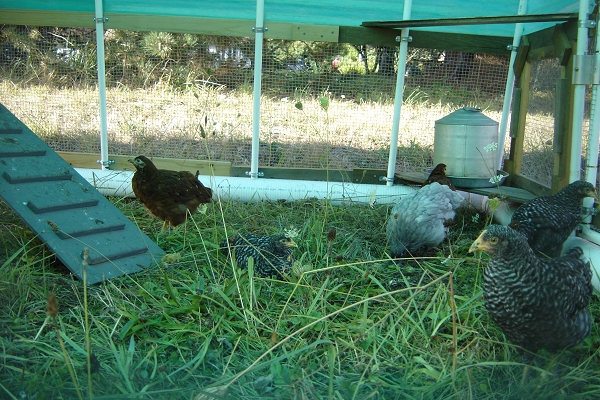
First Day Outside EVER
Trying to figure this all out.
First Day in the Pickle Palace
Orange smoke
Skies to the South
can't see the mountain
Skies to the West
filling with smoke
Meat Chicks are Here
Spotted Meat Chick
Still Smokey Thursday
looking south
Six Eggs after Thunderstorm
by ounces; 3.2 to 1.4
Back side of coop
Feeders and Ramp
Milling around
Sun after the rains
Checking out the fresh space
Pickle Palace
Fresh Grass after the move
Thru the gate to the coop